
Agentic AI: How AI Is Moving from Talking to Actually Doing
For years, AI impressed us by talking. In 2026, it's actually doing the work. Welcome to the era of Agentic AI—systems that independently set goals, use tools, and execute multi-step tasks with minimal human involvement. Learn how this revolution is transforming industries and how your business can get started.

Komal Yaseen
May 13, 2026·7 min read

Agentic AI: How AI Is Moving from Talking to Actually Doing
Introduction: The Era of "Doing" Has Begun
For the past few years, Artificial Intelligence impressed the world by talking. It answered questions. It wrote emails. It summarized documents. It generated images. The world was amazed — and rightfully so.
But in 2026, the game has changed completely.
AI is no longer just answering your questions. It is now doing your work.
Welcome to the era of Agentic AI — the most important shift in the history of Artificial Intelligence since the invention of the internet. This is not an upgrade. This is a revolution. And if your business is not paying attention, you are already falling behind.
What Is Agentic AI?
Let's start from the basics.
Traditional AI, like a chatbot or a writing assistant, works like this:
You ask → AI answers → You act
Agentic AI works completely differently:
You give a goal → AI plans → AI decides → AI acts → AI delivers results
Agentic AI is a system that can independently set goals, make decisions, use tools, and execute multi-step tasks — all with minimal human involvement. It does not wait for you to tell it what to do at every step. It figures out the steps on its own.
Think of the difference between a calculator and a personal assistant. A calculator waits for you to press the buttons. A personal assistant understands your goal, plans the steps, makes calls, books appointments, and reports back with results.
"Agentic AI is the personal assistant."
Why Is Everyone Talking About It Right Now?
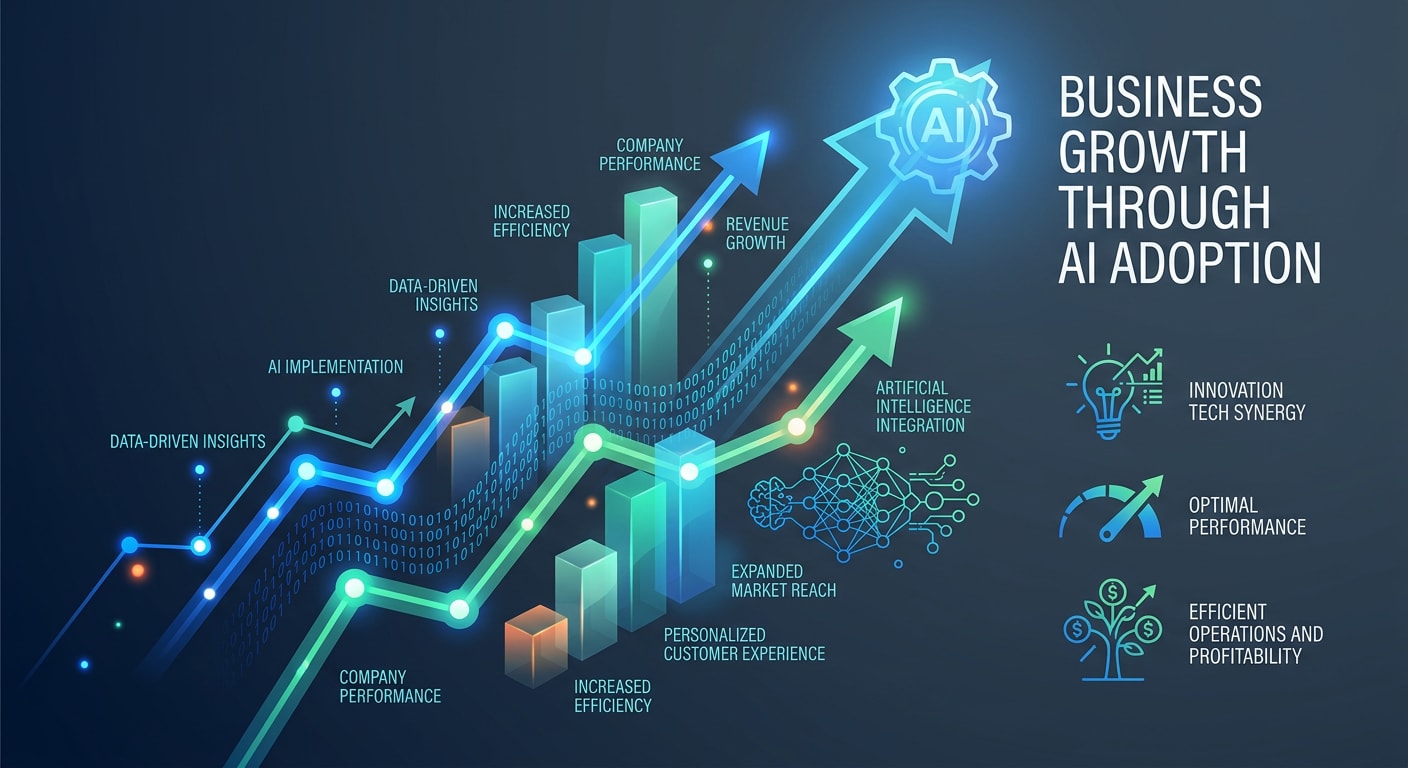
The numbers tell the full story:
Gartner predicts that 40% of enterprise applications will feature task-specific AI agents by the end of 2026 — up from less than 5% in 2025. That is an 8x increase in a single year.
65% of companies have already automated some workflows with Agentic AI, and they expect adoption to grow another 33% this year.
89% of enterprises plan to increase their AI investment in 2026 and beyond.
The global Agentic AI market is projected to grow from $5.2 billion in 2024 to over $196 billion by 2034.
This is not hype. This is the fastest technology adoption in enterprise history — faster than cloud computing, faster than mobile, faster than social media.
How Is Agentic AI Different from Regular AI?
This is the question most people ask.
Here is a clear comparison:
Feature | Regular AI (ChatGPT, etc.) | Agentic AI |
|---|---|---|
Works by | Responding to prompts | Pursuing goals autonomously |
Needs human input | At every single step | Only at the start |
Can use tools | Sometimes | Yes — browsers, APIs, databases, code |
Completes multi-step tasks | No | Yes |
Learns and adapts | Limited | Yes, in real time |
Example | Write me an email | Manage my entire email inbox and follow up on all pending deals |
The key difference is autonomy + action. Agentic AI does not just generate content. It takes actions in the real world.
Real-World Examples: What Agentic AI Is Doing RIGHT NOW
Here are real enterprise deployments happening today — not future predictions:
🏦 Finance (JPMorgan Chase): JPMorgan now runs 450+ active AI agent uses cases in production. Their agents generate investment banking presentations in 30 seconds — work that previously took junior analysts' hours. The same system automates trade settlement and detects fraud in real time across millions of transactions daily.
🏥 Healthcare (AtlantiCare): AtlantiCare deployed an agentic AI clinical assistant that cuts documentation time by 42% — freeing roughly 66 minutes per clinician per day. The system achieved an 80% adoption rate among providers in its very first test. That is time doctors now spend with patients instead of paperwork.
📦 Retail (Supply Chain Management): A major North American retailer reduced quarterly inventory losses from $5.4 million to $1.6 million after deploying AI agents to detect demand patterns and manage stock transfers autonomously.
⚖️ Government (IRS, USA): The IRS used Salesforce Agent force to cut the time to open tax court cases from 10 days to just 30 minutes — saving one division approximately 50,000 minutes per year.
💼 Customer Service (Salesforce Agent force): Salesforce's own AI agents handled over 380,000 customer support interactions and resolved 84% of cases fully autonomously — requiring human escalation for only 2% of cases.
These are not pilot programs. These are live, production systems delivering measurable results today.
The 4 Core Capabilities That Make Agentic AI Possible
For a technical audience, here is what powers Agentic AI under the hood:
Goal Setting & Planning: The agent receives a high-level objective and breaks it down into a sequence of logical subtasks on its own. It does not need a human to map out every step.
Tool Use: Agentic AI can operate external tools — web browsers, databases, APIs, code editors, calendars, email clients, and more. It does not just answer questions; it takes real actions in real systems.
Memory: Unlike standard AI, agentic systems retain context across long sessions. They remember what happened in step 1 when they are at step 47. They learn from past interactions and improve over time.
Multi-Agent Coordination: The most powerful agentic systems use teams of specialized agents working together. One agent research, another writes code, other tests it, another deploys it — all coordinating automatically, like a digital workforce.
Where Agentic AI Is Already Working Across Industries
Agentic AI is not a solution for one industry. It is reshaping every sector:
Customer Support: Agents independently triage, diagnose, and resolve support tickets end-to-end. No more ticket queues. No more waiting.
Software Development: AI coding agents write, test, debug, and deploy entire features autonomously. Engineers using agentic tools report dramatically higher output volume.
Finance & Banking: Automated KYC checks, loan calculations, fraud detection, portfolio management — all running 24/7 without human oversight. McKinsey reports 200% to 2,000% productivity gains in banks using Agentic AI for KYC/AML workflows.
Healthcare: Disease outbreak prediction, personalized treatment plans, clinical note generation, and hospital operations management.
Marketing & Sales: Agents that launch full outbound campaigns, manage follow-ups, qualify leads, and even book demos — without a human involved in the process.
Supply Chain: Real-time rerouting of shipments, predicting disruptions before they happen, and managing inventory across thousands of SKUs automatically.
The Honest Truth: Why 79% Adopt But Only 11% Run It in Production
Here is something that most blogs will not tell you. Despite all the excitement, 79% of enterprises say they have adopted AI agents — but only 11% actually run them in production.
Why such a massive gap? Moving from a proof-of-concept to a real production deployment involves challenges that do not show up in demos:
Data access and security boundaries: Agents need access to real systems, and that creates real risks.
Error handling and fallback logic: What happens when an agent makes the wrong decision?
Compliance and legal review: Autonomous AI actions must meet regulatory requirements.
Integration with legacy systems: Most enterprise software was not built with AI agents in mind.
This is exactly where a skilled software development partner becomes critical. Building agentic AI that actually works in production — reliably, securely, and at scale — requires deep technical expertise.
What This Means for Your Business
If you are a business owner or technology leader reading this, here is your takeaway:
The question is no longer "Should we use AI?"
The question is now: "How quickly can we build AI agents that replace our most repetitive, time-consuming workflows?"
Your competitors are already asking this question. Some of them are already acting on it. The businesses that will win in the next five years are not the ones with the biggest teams. They are the ones with the smartest AI agents working 24/7 on their behalf — booking meetings, managing inventory, resolving customer issues, writing reports, and monitoring systems — while their human teams focus on strategy and creativity.
How to Get Started with Agentic AI
Here is a simple 3-step approach for any business:
Step 1 — Identify your highest-volume, most repetitive workflows. Think about tasks your team does daily that follow a predictable pattern. Customer support responses, data entry, report generation, lead follow-up — these are ideal starting points.
Step 2 — Start with one agent, not ten. The biggest mistake companies make is trying to automate everything at once. Pick one workflow. Build one agent. Measure results. Then scale.
Step 3 — Partner with experts. Agentic AI is complex. It involves LLMs, APIs, tool integrations, memory systems, and safety guardrails. Working with a software development team that specializes in AI is not a luxury — it is how you avoid the 79% who experiment but never ship.
Conclusion: AI Is No Longer Talking. It Is Working.
"The chatbot era is over."
We have entered a new phase where AI does not just assist you — it acts for you. It plans, decides, executes, and delivers results. It works while you sleep. It scales without hiring. It operates without breaks, without bias, without forgetting.
Agentic AI is not a trend. It is the new foundation of how modern businesses will operate. The only question left is whether your business will build on that foundation — or watch your competitors do it first.
Want to explore how Agentic AI can be integrated into your business workflows? Our team specializes in building custom AI solutions that go beyond demos and actually deliver results in production.
(https://www.qubitars.com/contact-us).
© 2026 — All rights reserved. Written for informational and educational purposes.