
SEO Success in 2026: Metrics That Matter in Era of AI-Driven World
SEO in 2026 is no longer about rankings alone. With AI-driven search and zero-click results, success now depends on visibility in AI overviews, engagement depth, and revenue-focused metrics that reflect real business impact.

Maham Mehar
June 19, 2026·8 min read

SEO in 2026: Beyond Clicks in an AI-First Search Landscape
If your analytics show falling CTRs and rising zero-click searches, you’re not alone. 65% of informational queries now resolve without a website click as LLMs deliver direct,
synthesized answers in the SERP. This doesn’t mean organic traffic is dead. It means old measurement models are. Ranking reports alone no longer reflect real visibility or business value.
LLMs integrated into search have changed user behavior. People consume AI summaries, not isolated blue links. To stay relevant, we must re-engineer how we track and prove organic performance. The priority for digital strategists now: move past AI panic and build systems that tie digital presence to business outcomes. That means knowing which metrics are obsolete, which remain foundational, and how to measure brand visibility across both traditional and generative search.
What SEO Success Really Means in 2026
Historically, SEO focused on keyword matching to secure rankings and drive traffic. Today, success means becoming a trusted authority that AI systems and search engines use to generate direct answers. Visibility is now measured across both traditional search results and AI-driven answer systems, where your content must influence how responses are formed. Strong performance means being part of the core information users see during commercial decision-making journeys.
At the same time, technical health remains critical—fast loading, clean structure, and smooth user experience ensure your site is properly crawled, ranked, and retained in modern search ecosystems. Ultimately, brands that combine authority, structured content, and technical excellence are
the ones that sustain long-term visibility and conversion growth.
Why Traditional SEO Metrics Are Not Enough Anymore
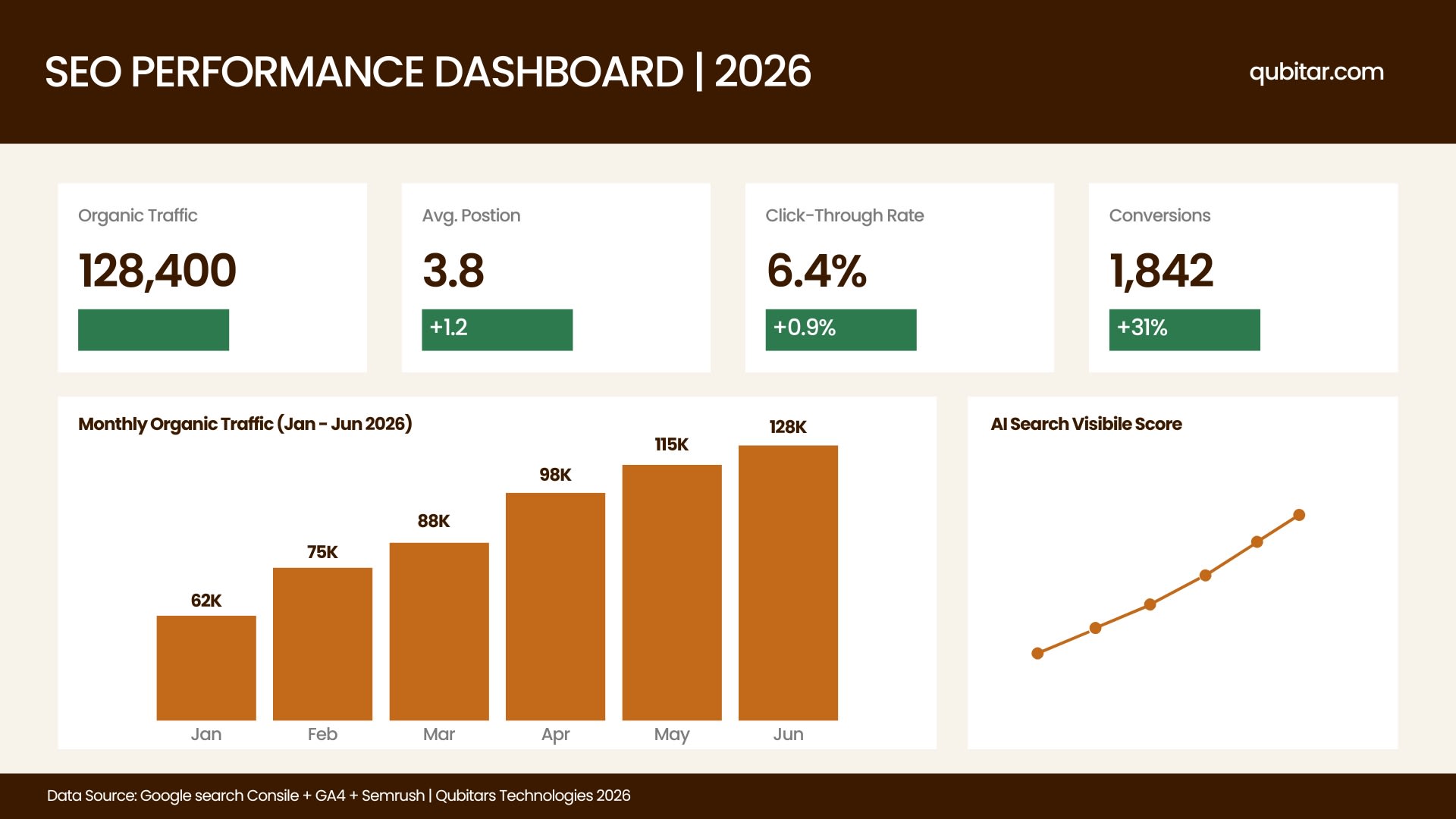
For nearly two decades, digital reporting focused on a simple trio: keyword rankings, raw traffic, and bounce rates. However, in today’s AI-driven search environment, these metrics no longer provide a complete picture of performance.
A page can hold a top ranking yet still lose significant traffic because AI overviews answer user queries directly on the results page. At the same time, raw traffic is often inflated by bots and non-transactional visits, making it unreliable for measuring real business impact. Even bounce rates are misleading—users may find the exact information they need quickly and leave satisfied, which still reflects a successful brand interaction rather than a failure.
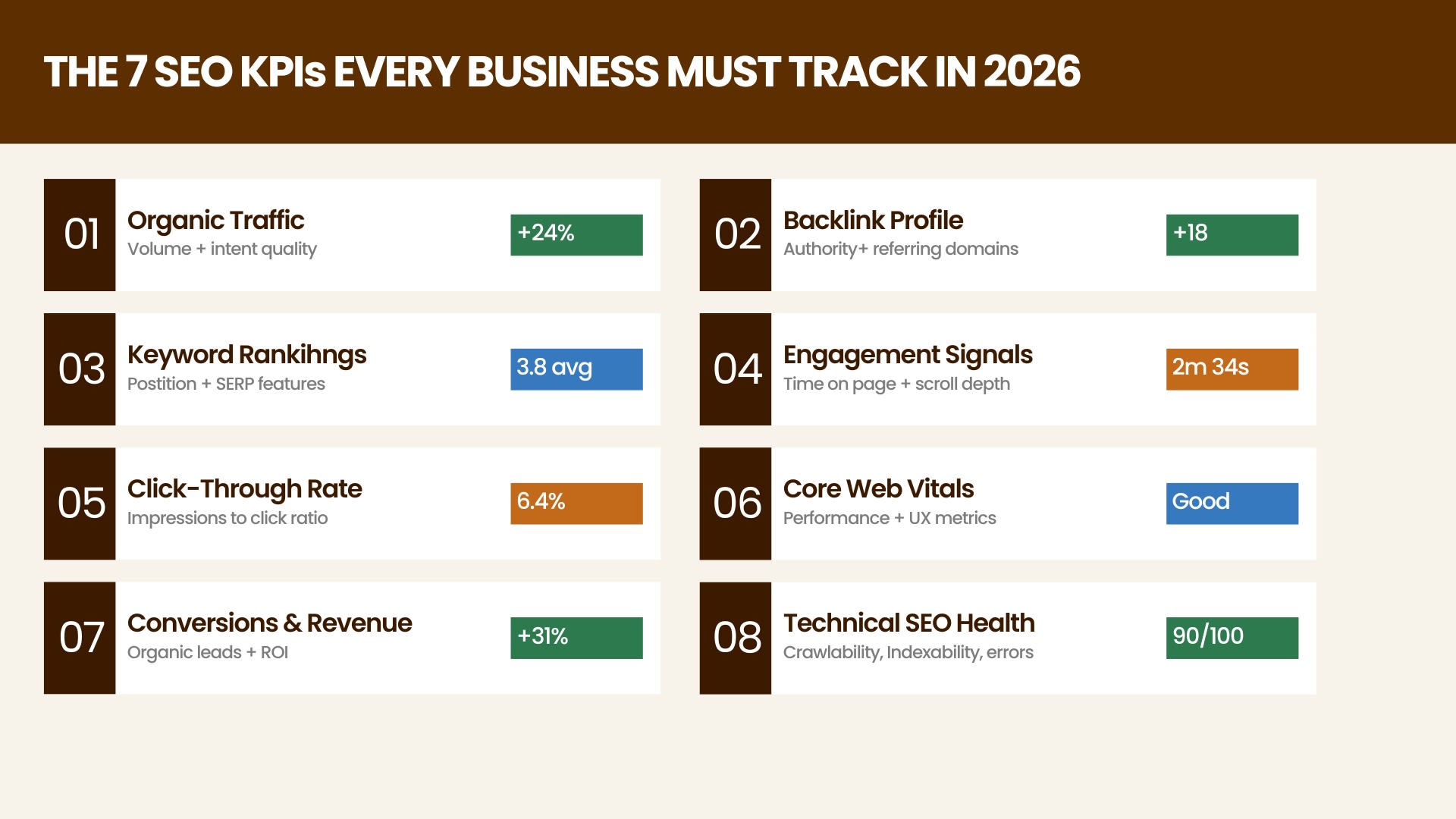
Core SEO Metrics That Still Matter
While the operational landscape has experienced significant adjustments, several traditional, core indicators remain critical components for successfully measuring SEO
performance across modern platforms. These foundational pillars provide the essential data backbone required to validate your underlying site architecture, verify content alignment, and ensure technical compliance.
1. Organic Traffic
Measures the number of visitors coming from search engines. Focus on high-intent, non-branded traffic to understand if your SEO is attracting qualified prospects.
2. Keyword Rankings
Tracks your website’s positions for target keywords. Improving rankings increases visibility and helps capture more relevant search demand.
3. Click-Through Rate (CTR)
Shows how effectively your search snippets attract users. A higher CTR indicates strong titles, descriptions, and messaging that encourage clicks.
4. Conversions & Revenue
Measures how organic traffic contributes to leads, sales, and business growth. SEO success is determined by the quality and value of conversions, not just traffic volume.
5. Backlink Profile
Evaluates the quality and authority of websites linking to your domain. Strong backlinks improve credibility and support higher search visibility.
6. Engagement Signals
Tracks user behavior such as time on page, pages per session, and interactions. Positive engagement signals indicate that your content meets user intent.
7. Core Web Vitals & Page Experience
Measures technical performance factors like loading speed, visual stability, and responsiveness. A strong page experience improves usability and supports better search performance.
8. Technical SEO Health
Monitors crawlability, indexing, site structure, and technical issues. A healthy technical foundation helps search engines discover and rank your content effectively.
New AI-Driven Metrics You Must Track
To stay competitive in modern commercial spaces, enterprise marketing teams must expand their evaluation stacks to incorporate advanced, AI-driven SEO metrics that
capture user visibility within generative search systems. These specialized data layers reveal exactly how effectively your digital content assets are parsed, integrated, and
cited by interactive search systems.
- Visibility in AI Overviews and GEO Citations
Generative Engine Optimization performance represents the new frontier of tracking digital authority and brand prominence. You must systematically evaluate your brand
citation rates, checking how frequently your content is leveraged as an active reference link within LLM answer windows. Tracking these citations ensures you can measure
whether your underlying content architecture is successfully feeding the automated systems that guide modern consumer selection paths.
- Branded Search Demand
When your non-branded content successfully appears inside interactive AI summaries, it naturally sparks a downstream wave of direct interest in your company. Tracking the steady expansion of your branded search query volumes serves as an excellent strategic metric for measuring modern organic awareness. As more prospective clients specifically search for your brand name alongside targeted service phrases, it proves your high-level optimization efforts are successfully building long-term marketplace
mindshare.
- Engagement Depth and Behavioral Signals
Because modern search systems actively evaluate post-click user actions to verify content authority, tracking internal engagement parameters is non-negotiable. You must
implement robust event monitoring to track active scroll percentage records, interaction window lengths, video views, and asset download triggers. If you are not sure where to start your technical audit, consider leveraging specialized resources like professional
SEO services to centralize all your behavioral indicators and technical conversion paths into one high-performance corporate tracking configuration. Monitoring these deep interactive signals allows your development teams to optimize your content layouts, ensuring that every user visit delivers concrete proof of value back to search engines.
How to Build a Simple SEO Measurement Framework
Transitioning your marketing reports to align with modern SEO KPIs in 2026 does not require establishing overly complex data systems. Instead, you can construct an airtight, highly actionable governance framework by grouping your core target metrics into three distinct operational performance layers.
Leading Indicators Layer (Weekly Tracker): Tracks foundational technical indicators including Core Web Vitals compliance, crawling health parameters, snippet impression scales, and overall keyword position shifts across your target terms.
Interaction Performance Layer (Monthly Audit): Tracks high-value audience behaviors including non-branded organic traffic sessions to high-intent pages, explicit conversion event interactions, and brand citation rates inside major AI engine tools.
Commercial Impact Layer (Quarterly Review): Connects your digital data points directly to executive business indicators, tracing closed organic pipelines, lead acquisition costs, and total attributed revenue growth charts.
By managing your organic analytics reporting using this clear, multi-tiered architecture, you eliminate unnecessary data noise and keep all company stakeholders aligned. Your technical engineering teams can focus completely on weekly leading indicators, your content strategists can analyze monthly interaction behaviors, and your executive board receives clear, metric-driven proof of direct commercial contribution.
Tools and Dashboards to Measure SEO in 2026
Successfully tracking complex AI search and SEO analytics across distributed modern platforms requires deploying a carefully curated, integrated collection of operational tools. You do not need to purchase a massive array of expensive platforms; instead, focus on connecting a core set of specialized applications that talk to one another smoothly.
Google Search Console (The Technical Foundation): Remains the absolute gold standard for extracting direct, unmanipulated interaction data from the primary index. Use it to audit exact impression data, verify snippet performance trends, and evaluate technical optimization configurations.
Google Analytics 4 (The Behavioral Core): Allows you to build detailed target user segments, trace complete customer journeys across active touchpoints, and track multi-touch attribution metrics to prove organic value.
Semrush or Ahrefs (Market Intelligence & Position Analytics): Essential platforms for monitoring holistic market movements, auditing competitor search portfolios, tracking specific SERP feature ownership, and monitoring brand visibility changes.
Brand24 or AI Tracker Platforms (GEO Monitoring): Provides deep programmatic monitoring across interactive large language systems, alerting your team whenever your brand assets are used as information sources inside generative responses.
Looker Studio (The Unified Executive Dashboard): The optimal system for pulling separate data points into a clean, unified corporate interface that updates automatically for streamlined stakeholder review.
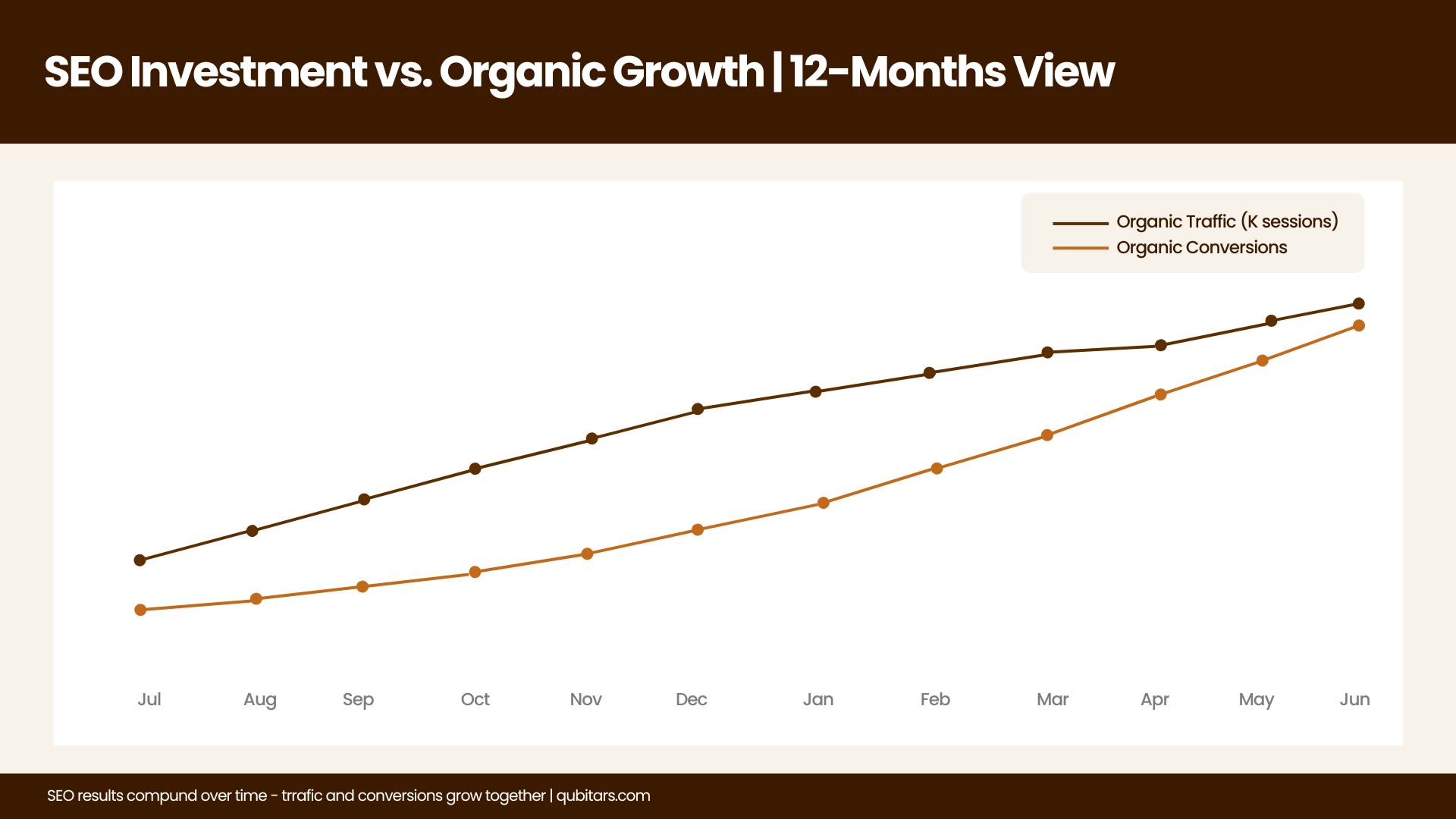
The true secret to modern tracking efficiency is automated data visualization. By feeding your search console pipelines, behavioral metrics, and attribution models into a single, cohesive dashboard, you eliminate manual reporting delays and empower your execution teams to react instantly to algorithm updates.
>> Real-World Example: Turning Data into Decisions
A high-growth B2B application firm achieved a 40% increase in keyword visibility across 150 business terms, but CTR dropped by 22% as AI overviews began resolving queries directly in search results.
Using these insights, the team refined their content strategy with answer-first sections, structured tables, and schema markup, leading to AI overview citations within six weeks and a 35% increase in high-intent trial conversions.
This shift improved their search visibility in AI-driven SERP environments and strengthened their ability to attract qualified, intent-driven users at the top of the funnel.
Common Mistakes to Avoid When Measuring SEO
As your business works to refine its analytical processes, you must remain vigilant against several widespread reporting errors that can waste resources and degrade campaign effectiveness. Being aware of these traps ensures your team maintains absolute data integrity.
Mistake 1: MoM Seasonality Blindspots. Evaluating month-over-month traffic numbers without accounting for standard corporate sales cycles can lead to incorrect strategic adjustments. Always calculate your data trends on a Year-over-Year model to remove seasonal volume noise.
Mistake 2: Conflating Branded and Non-Branded Metrics. Branded traffic represents market demand that has already been captured by your broader marketing campaigns. You must completely isolate non-branded search vectors to accurately verify true SEO customer acquisition health.
Mistake 3: Relying on Last-Click Attribution Models. Because organic interactions typically occur at the initial exploratory stages of a buyer journey, relying on single-click reporting models severely misrepresents your true financial return. Ensure you deploy data-driven attribution settings.
By actively eliminating these common analytical missteps from your monthly evaluation routines, you protect your optimization investments, ensure transparent stakeholder communication, and build an unshakeable baseline for long-term growth.
Final Thoughts and What to Do Next
Achieving sustained SEO success in 2026 does not mean we must fear the continuous evolution of artificial intelligence search applications. Instead, it invites us to step forward as mature data-driven leaders who understand that true digital prominence is built by combining traditional technical health with modern generative visibility metrics.
Your immediate, high-value action step from this guide is to conduct a thorough audit of your existing marketing report dashboards. Work directly with your content production and data analytics teams to phase out empty vanity metrics, isolate your high-intent traffic segments, and introduce active tracking for generative engine citations.
The future belongs to agile organizations that can translate intricate search signals into decisive, revenue-generating product improvements. Establish your simple measurement framework today, deploy the proper data connection tooling, and turn search engine updates into a continuous engine for business scale and authority.