
Retrieval-Augmented Generation (RAG): The Future of AI-Powered Knowledge Systems
Discover how Retrieval-Augmented Generation (RAG) enhances AI by combining real-time knowledge retrieval with large language models. Learn how RAG improves accuracy, reduces hallucinations, and powers enterprise AI applications.
Maham Mehar
July 17, 2026·7 min read

Retrieval-Augmented Generation (RAG): The Future of AI-Powered Knowledge Systems
Artificial intelligence has fundamentally changed how we interact with information. Large Language Models (LLMs) can write code, draft essays, and answer complex questions in seconds. Yet, traditional generative AI applications face a critical bottleneck: they are frozen in time, limited strictly to the data they were trained on.
When a standard AI model encounters a query about recent events, proprietary company files, or real-time data, it often stumbles or fabricates information. To bridge this gap, a groundbreaking architecture has emerged as the gold standard for enterprise AI solutions. It is called Retrieval-Augmented Generation (RAG).
By anchoring generative models to real-time external knowledge, RAG transforms static algorithms into dynamic, highly accurate business tools. This comprehensive guide breaks down what RAG is, how it works, and why it represents the future of enterprise knowledge management.
What is Retrieval-Augmented Generation (RAG)?
At its core, Retrieval-Augmented Generation (RAG) is an AI framework that optimizes the output of a large language model by referencing an authoritative, external knowledge base before generating a response.
To understand RAG, think of a traditional LLM as a student taking an exam in a closed room with no notes. The student might be incredibly smart, but they can only rely on what they memorized months ago. If the exam asks about a brand-new market trend, the student is forced to guess.
RAG turns this closed-book exam into an open-book exam. When a user asks a question, the system searches through a specific library of documents, finds the exact pages relevant to the question, and hands them to the AI. The AI then reads those pages and writes a perfectly accurate, context-aware answer.
Combining Retrieval with Generation
RAG blends two distinct technical systems into a single seamless workflow:
The Retrieval System: A digital librarian that searches an external database to find factual, up-to-date documents matching the user's prompt.
The Generative System: The core LLM that takes the retrieved documents and translates them into natural, conversational language.
By pairing these two components, organizations no longer need to spend millions of dollars retraining massive models just to keep their AI's knowledge base current.
How RAG Works: A Step-by-Step Breakdown
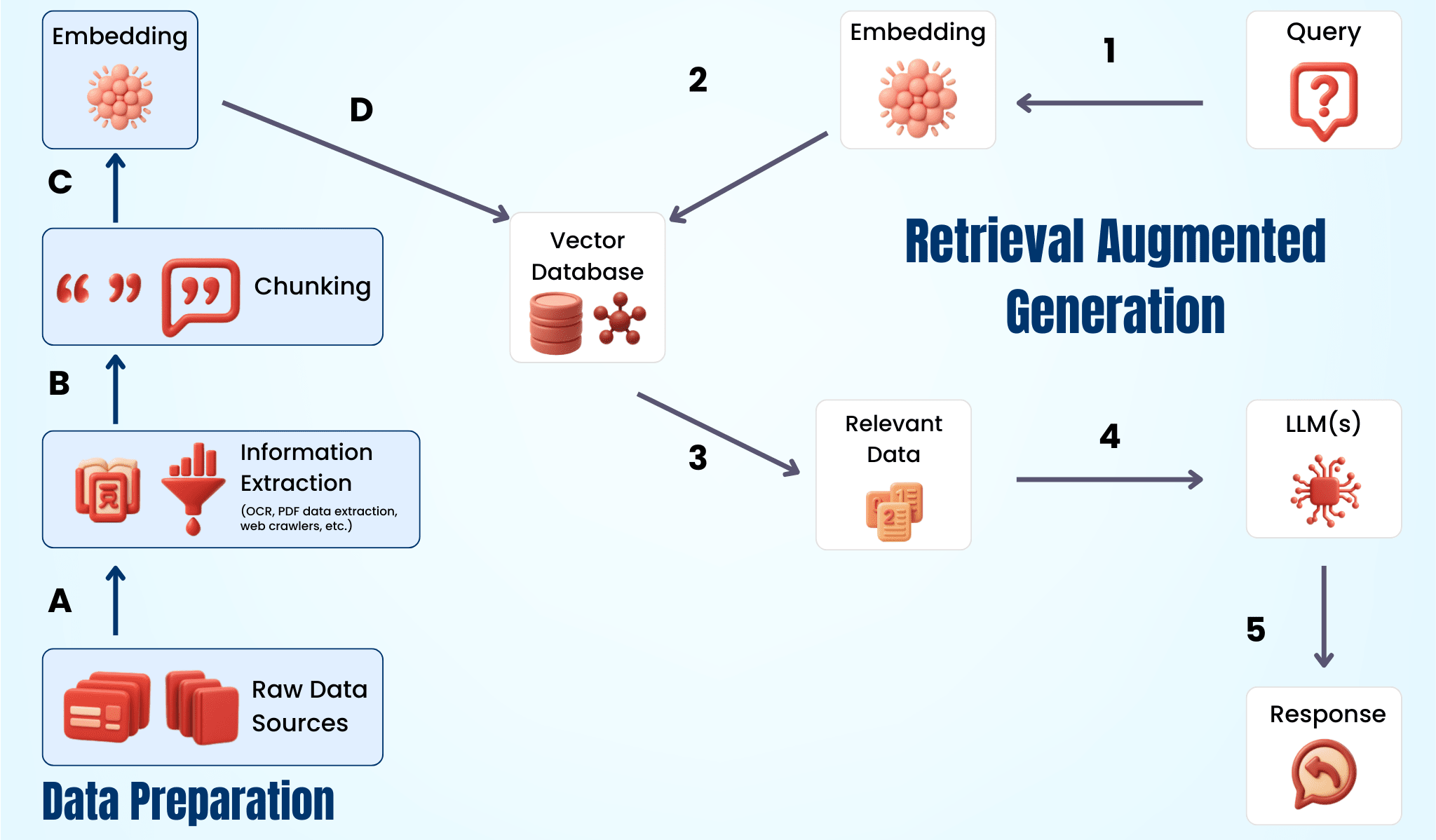
Building effective generative AI applications requires a clear understanding of the data pipeline. The RAG workflow can be broken down into four clear, sequential stages.
1. Ingestion and Vectorization
Before a system can retrieve data, it must understand it. Raw data—such as PDFs, internal wikis, customer support logs, and databases—is broken down into small, digestible chunks. These chunks are then converted into numerical representations called embeddings using an embedding model. These embeddings are stored in a specialized system known as a vector database AI.
2. The User Query
A user inputs a prompt into the system, such as: "What is our company's policy on remote work equipment reimbursement?" The system immediately converts this query into a numerical vector using the exact same embedding model used during data ingestion.
3. Contextual Retrieval
The system compares the vector of the user's query against the vectors stored in the vector database AI. Through mathematical similarity matching, the database retrieves the specific chunks of text that contain the answers, ignoring thousands of pages of irrelevant files.
4. Augmented Generation
The retrieved text chunks, along with the original user prompt, are bundled together into a comprehensive instructions package called an "augmented prompt." This package is sent to the LLM. Because the LLM now has the exact reference text right in front of it, it generates a highly accurate, citation-backed response to the user.
Benefits of RAG in Real-World Applications
Implementing RAG provides immediate, tangible benefits for businesses looking to deploy AI safely and efficiently.
Radical Reduction in Hallucinations
Standard generative AI applications are notorious for "hallucinating"—generating false facts with absolute confidence. Because RAG forces the AI to base its answers strictly on verified source documents, the risk of hallucination drops dramatically. If the answer isn't in the provided documents, the system can simply say, "I cannot find this information in the database."
Real-Time Knowledge Integration
Training an LLM from scratch or fine-tuning it can cost thousands of dollars and take weeks of computing time. With RAG, updating your AI’s knowledge is as simple as adding, deleting, or updating a text file in your vector database. The AI instantly gains access to the new information without a single minute of model retraining.
Data Security and Access Control
For enterprises, data privacy is non-negotiable. RAG architectures allow companies to implement strict access controls. The retrieval system can be designed to only pull documents that the specific user has permission to view, ensuring sensitive HR or financial data is never exposed to unauthorized personnel.
Types of RAG (Retrieval-Augmented Generation)
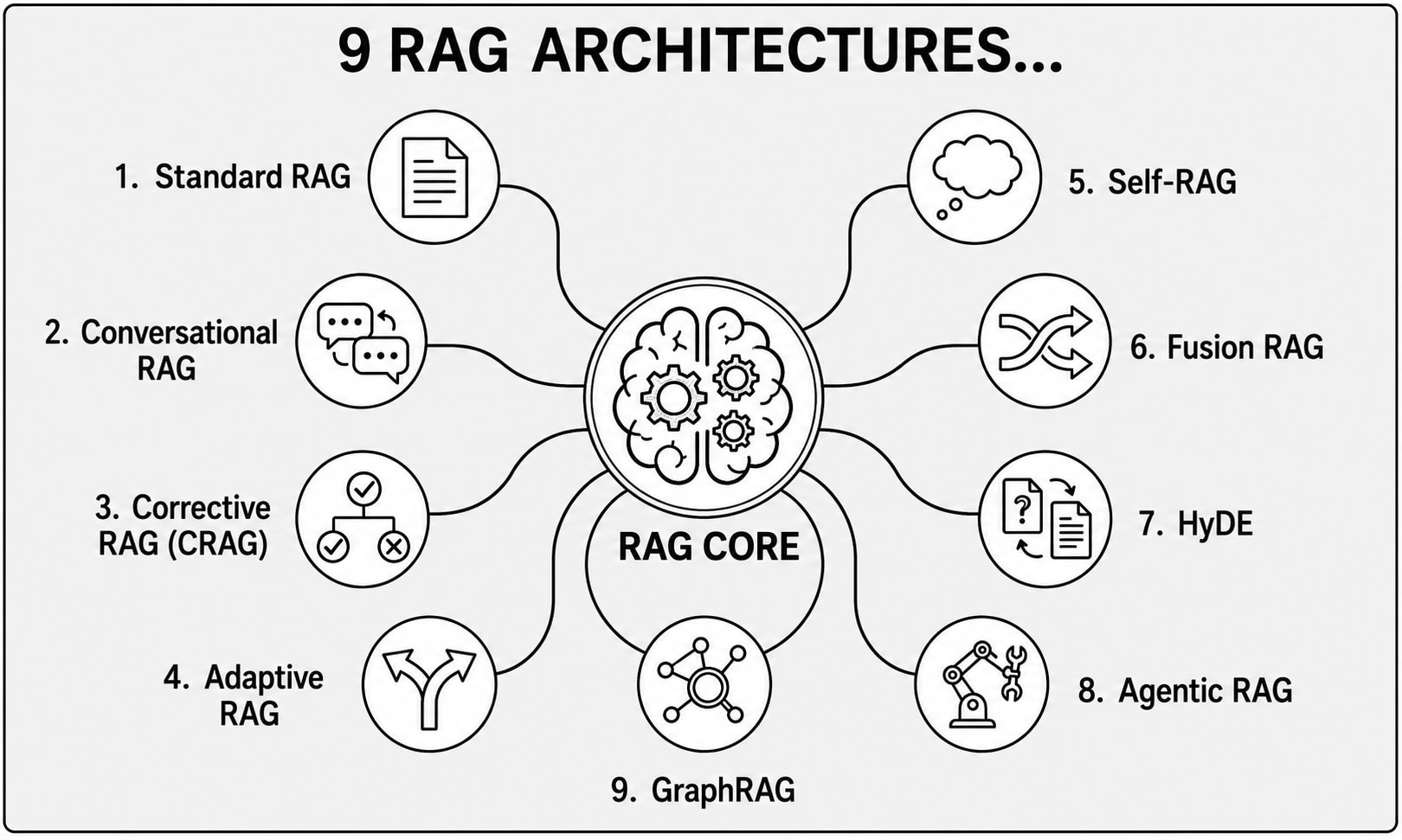
To maximize accuracy and efficiency, RAG architectures have evolved beyond simple keyword searches into advanced, multi-stage retrieval systems:
Standard RAG: A baseline architecture that fetches database text chunks via vector search and passes them straight to the LLM without any pre-processing, post-retrieval filtering, or real-time optimization layers.
Conversational RAG: Optimizes multi-turn dialogue by tracking chat history and dynamically rewriting subsequent prompts, ensuring the system retrieves highly relevant context throughout an ongoing, continuous conversation.
Corrective RAG (CRAG): A self-correcting model that evaluates retrieval quality and relevance before generation, automatically triggering external web searches to pull real-time facts if internal data is low-quality.
Adaptive RAG: A dynamic framework that runs queries through a classifier model to assess complexity, routing simple questions to quick lookups and complex requests to multi-step pipelines.
Graph RAG: An advanced paradigm using structured Knowledge Graphs instead of basic text chunks to map explicit entity relationships, allowing the LLM to resolve complex, high-level structural questions.
Self-RAG: An end-to-end model that trains the LLM to output reflection tokens, allowing the system to autonomously critique its own retrieval necessity, text relevance, and generation accuracy on the fly.
RAG Fusion: Generates multiple variations of a user prompt, executes vector searches for all variations simultaneously, and uses Reciprocal Rank Fusion to rank and surface the absolute best context.
HyDE RAG: Directs the LLM to generate a mock, hypothetical answer first, utilizing that idealized text to perform the vector search and significantly improving semantic similarity matching against actual source files.
Agentic RAG: Combines the retrieval pipeline into an autonomous agent framework where the LLM decides when to search, loops through documents iteratively, and formulates the ultimate resolution independently.
Strategic Enterprise Use Cases
Organizations across the globe are leveraging RAG to optimize workflows, unlock hidden data insights, and elevate customer experiences.
-> Next-Generation Customer Support Chatbots
Traditional support bots rely on rigid, pre-written scripts that frustrate users. RAG-powered chatbots access your live product documentation, return policies, and past troubleshooting tickets to answer highly specific customer queries in real time, reducing escalation rates.
-> Internal Knowledge Management Systems
Large enterprises lose countless hours to employees searching for internal information buried in scattered drives. A RAG-driven AI knowledge system serves as an intelligent internal oracle, instantly pulling exact answers from company wikis, compliance guidelines, and historical project files.
-> Advanced AI Search Engines
Standard keyword searches only look for exact text matches. RAG systems utilize semantic search, meaning they understand the underlying intent behind a user's question. This allows research teams, legal analysts, and financial consultants to find conceptually relevant data across millions of pages of research papers or legal contracts instantly.
To explore how these architectures can transform your business operations, you can leverage custom AI solutions by Qubitars to design secure, scalable, and tailored data pipelines.
Challenges and Limitations of RAG
While RAG is incredibly powerful, successful implementation requires overcoming specific technical and operational hurdles.
Data Quality and Dependency: A RAG system is only as good as the data fed into it. If your internal documentation is outdated, contradictory, or poorly structured, the system will retrieve bad information, leading to inaccurate outputs.
Infrastructure Complexity: Setting up a robust RAG pipeline requires integrating multiple components, including data ingestion scrapers, embedding models, vector databases, and LLM orchestration frameworks. Maintaining this pipeline requires dedicated engineering oversight.
Cost and Latency Considerations: Every user query involves an extra step: searching the database before generating text. If not properly optimized, this can introduce minor latency. Additionally, processing large volumes of data through third-party APIs can accumulate costs if vector search routines are inefficient.
The Future of RAG in AI Systems
As machine learning continues to advance, RAG is evolving from a basic search-and-retrieval tool into an autonomous agentic framework.
The future of RAG lies in "Multimodal RAG"—systems capable of retrieving and generating not just text, but images, video, charts, and architectural blueprints. Furthermore, modern vector database AI systems are becoming faster and cheaper, allowing organizations to query terabytes of enterprise data in milliseconds.
As businesses race to integrate AI into their core operations, building standalone LLM applications is no longer enough. Success requires building systems that are deeply integrated with proprietary data, highly secure, and auditable. RAG addresses all of these requirements, making it an indispensable pillar of modern enterprise architecture.
For organizations looking to deploy these advanced architectures without navigating the technical complexities alone, you can tap into the specialized Qubitars AI development expertise to build custom enterprise solutions tailored to your unique operational workflows.